How to Choose the Most Suitable Sauna for Your Family?
The family sauna room is no longer merely an accessory of luxurious residences; instead, it has become a core component of the modern "backyard wellness ecosystem". With a wide range of choices available on the market, how can you select the one that suits you best? This guide will provide you with professional advice from four dimensions: core technology, material selection, space planning, and installation safety.
Dimension | Infrared Sauna | Traditional Finnish Sauna |
Heating Principle | Uses far-infrared rays to penetrate subcutaneous tissues and heat the body directly. | Heats the air via an electric or wood-burning stove, which indirectly transfers heat to the body. |
Operating Temperature | 120°F – 150°F (48°C – 65°C) - Gentle and highly breathable heat. | 150°F – 195°F (65°C – 90°C) - Intense and high-impact heat. |
Humidity Control | Dry heat only; water should not be added to heaters. | Allows for löyly (steam) by pouring water over heated sauna rocks. |
Warm-up Time | Fast; typically ready in 10–20 minutes. | Slower; requires 30–45 minutes to heat the air and rocks. |
Target Audience | Users seeking deep detoxification, joint relief, and daily recovery. | Enthusiasts seeking an authentic spa ritual and high-intensity sweating. |
II. Material Selection: Not only about appearance, but also about durability
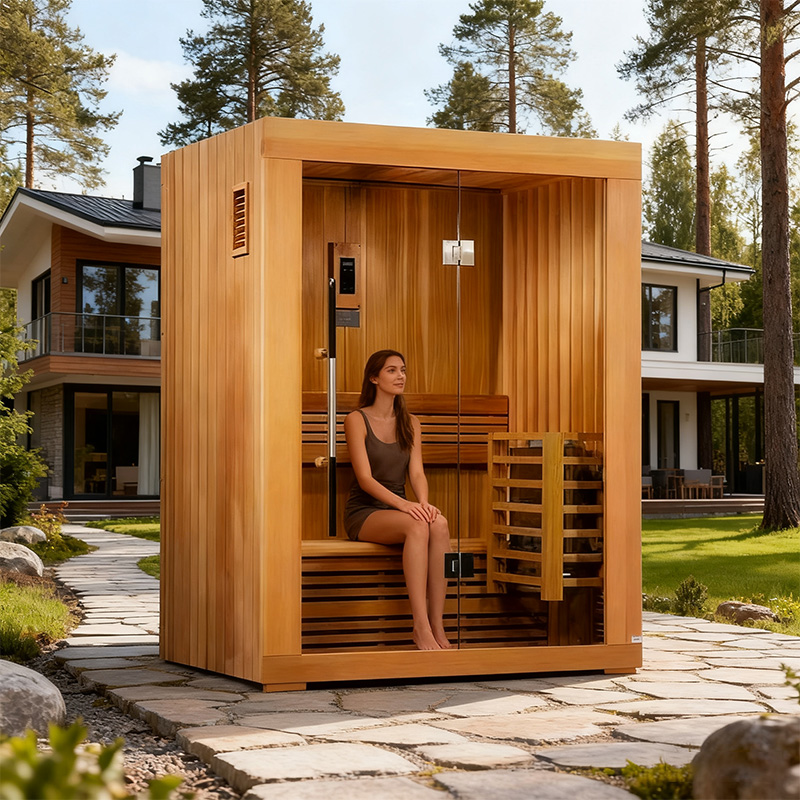
The choice of wood affects the corrosion resistance, aroma and anti-allergy properties of the sauna room.
Canadian Red Cedar: The top-of-the-line option. Naturally resistant to decay and insects, it has a rich woody aroma and evenly distributed heat.
Canadian Hemlock: A cost-effective option for allergy prevention. It has no odor and a hard texture, making it ideal for users who are sensitive to strong wood scents.
III. Space and Power Planning
Incorrect power configuration can lead to low heating efficiency or circuit malfunctions.
"1kW Golden Rule": For traditional saunas, it is usually configured based on a power of 1kW corresponding to 1 cubic meter of space.
Circuit requirements:
For small infrared models (for 1-2 people), a standard 110V/15A socket is usually supported.
For traditional saunas and large infrared models, an independent circuit of 220V/30-50A is typically required, and it must be hard-wired by a professional electrician.
Floor area: For single or double occupancy, it is usually about 1x1 meter or 1.2x1.2 meters; for 4 or more occupants, it is recommended to reserve a space of 1.5x1.8 meters or larger.
IV. Safety and Installation Tips
Surface Selection: For indoor installation, it must be placed on non-porous, heat-resistant surfaces (such as tiles, resins, or concrete). It is strictly prohibited to place it on carpets as it may accumulate moisture or cause a fire.
Ventilation system: Ensure there are passive or mechanical exhaust vents. Good ventilation can provide sufficient oxygen and prevent the growth of mold.
Outdoor foundation: The outdoor unit must be placed on a level and sturdy foundation (such as a concrete pad or paving stones).